



These days, there’s a long list of gender identities you can belong to, more genders than you’d ever have thought possible. Pretty soon, there’ll be more genders in the world than surviving species.
The well-intended mission of these gender identities is to help people feel that there’s a place where they belong—that all we need to do it fly the right flag and we’ll find our tribe.
Maybe if you’re trying very hard not to fit into a category, you probably do fit somewhere. But what if you really don’t fit into any of these categories? What if you’re one of nature’s naturally occurring oddballs?
On Being an Oddball
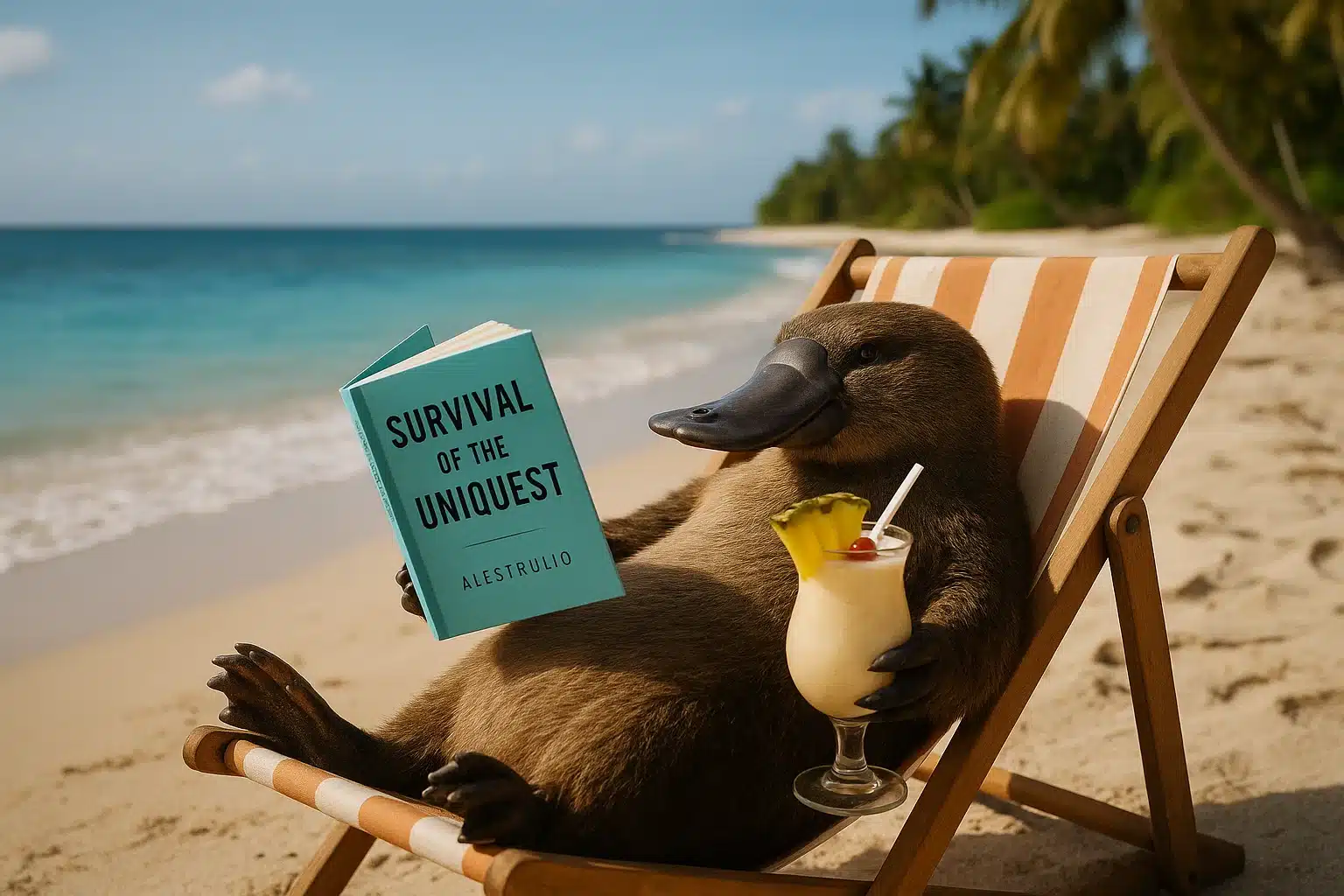
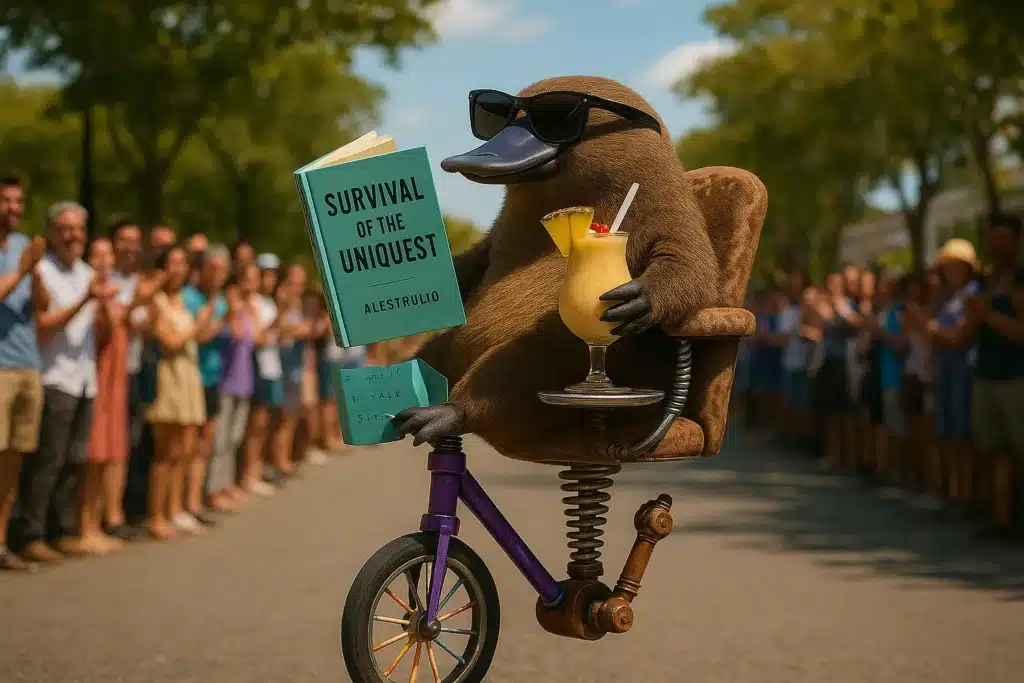
When European scientists first encountered the platypus in 1798, they thought it was a hoax. Here was a creature with the bill of a duck, the tail of a beaver, and the body of an otter. It laid eggs like a bird but nursed its young like a mammal. It had venomous spurs like a reptile but fur like a warm-blooded animal.
The platypus didn’t just blur the lines between categories; it seemed to gleefully ignore them altogether.
The scientific community spent decades arguing about how to classify this biological rebel. Was it a mammal? A bird? Some primitive link between reptiles and mammals? The platypus didn’t care about their debates. It simply continued being itself: swimming in Australian rivers, hunting with electroreception, chilling out, and thriving in its own unique way.
If you’ve ever felt like you don’t quite fit into the neat categories that society has laid out—whether in terms of gender, religion, culture, or any other aspect of identity—you might understand how the platypus feels. You’re not alone in this experience, and, like the platypus, your inability to be easily categorised isn’t a flaw. It might just be your superpower.
The Human Need for Categories
Humans love categories. Our brains are pattern-recognition machines, constantly sorting information into mental boxes to make sense of the world. This tendency serves us well in many ways—it helps us navigate complex environments and make quick decisions, and communicate efficiently. But when it comes to human identity, our love affair with rigid categories can become a prison.
Think about the forms you fill out, the boxes you’re asked to check, the labels you’re expected to choose from. Male, female or something else? Gay, straight or one of the others? Which religion? On it goes.
These choices might work for some people—how we love the quizzes that set our personality type in stone—but for many, they feel like trying to squeeze into a pair of shoes where one’s too big and the other’s too small.
The truth is, human identity has always been more complex than our categories suggest. Just as nature produced the platypus—defying our neat animal classifications—human diversity produces people who exist in the spaces between, beyond, and outside traditional labels.
You might:
Be someone who feels deeply spiritual but doesn’t connect with organised religion.
Experience gender in ways that don’t align with binary expectations.
Find that your cultural identity draws from multiple traditions, or that your personality traits don’t fit neatly into any psychological profile.
Even discover, from an ancestry test, that your ethnicity isn’t what you (and everyone) always thought.
Finding Your Identity in the Great In-Between
The journey of finding your identity when you don’t fit into conventional categories can feel lonely and confusing. You might wonder if there’s something wrong with you, or feel pressure to pick a side just to belong somewhere. But consider this: the platypus didn’t become a hopeless misfit when scientists couldn’t figure out a classification. It proved that its unique combination of traits makes it extraordinarily well-adapted to its pretty harsh environment.
Similarly, your unique combination of traits, experiences, and perspectives isn’t a bug, it’s a feature—if you’ll excuse a slight cliché. The very fact that you don’t fit neatly into existing categories means you’re exactly who you’re supposed to be.
Finding your identity isn’t about forcing yourself into a pre-existing mould. It’s about understanding and embracing your authentic self, even when that self doesn’t match any template.
The world is slowly learning what scientists eventually accepted about the platypus: sometimes the most extraordinary things are the ones that don’t fit our expectations.
This process of self-discovery can be particularly challenging for young people navigating questions about gender and religion—two areas where society’s frowning and demanding expectations can feel especially rigid. Even the coaxing pressure to be different or transgressive can be oppressive when you’d like to make the journey in your own way.
If you find yourself somewhere on the gender spectrum that doesn’t align with traditional binary categories, or if your spiritual beliefs draw from multiple traditions or exist outside organised religion altogether, you’re probably in a constant battle to explain yourself or defend your right to exist as you are. Maybe even to yourself. But you don’t need to be.
Because here’s what the platypus teaches us—that categories exist to describe reality, not define it, and when reality doesn’t fit the categories, it’s the need to categorise that’s the issue. In The Making of Brio McPride, you’ll find several people who need to figure this out.
Building Your Own Nest
Platypuses don’t live in typical mammal dens or bird nests. They dig burrows in riverbanks—creating homes that work specifically for their unique needs. This is a powerful example for those of us who don’t fit traditional categories: sometimes you have to build your own spaces and communities.
This might mean seeking out others who share your experience of being in-between or just nothing to do with those relentless lists. Online communities, support groups, and chosen families can provide the understanding and acceptance that traditional structures might not offer.
It might mean creating new language to describe your experience, or reclaiming and redefining existing terms. It might mean setting boundaries with people who insist you must choose a single category—surrounding yourself with those who celebrate your complexity or contented simplicity.
Remember that throughout history, it’s been the people who didn’t fit in—the ones who saw the world differently, who couldn’t or wouldn’t conform—who have driven progress and expanded our understanding of what it means to be human.
Every person who lives authentically despite not fitting into categories makes it easier for the next person to do the same.
The Courage to Be Uncategorisable
Living as a ‘platypus’ in a world of rigid taxonomy and the need for black and white definitions takes courage. There’ll be days when you wish you could just pick a box and fit neatly.
There’ll be many people who don’t understand you, who insist that you must be one thing or another—people who can’t get their head around your unlabellability.
But there will also be moments of profound freedom in refusing to be confined. There will be connections with others who recognise and celebrate your authenticity. There will be the deep satisfaction of knowing that you’re living as your true self, not a diminished version designed to make others comfortable.
The platypus survived and thrived not despite its unusual combination of traits, but because of them. Each seemingly contradictory feature serves a purpose in its life. Your complexity, your refusal to fit into simple categories, your unique perspective—these aren’t obstacles to overcome but gifts to cultivate.
If you’re struggling to find your identity in a world that demands conformity, remember the platypus. Remember that you’re not broken or confused—you’re complex and authentic.
The world needs people who live in the spaces between categories, who show us that human experience is richer and more varied than any classification system could capture.
Above all else, remember that by constant evolution and change, nature itself rebels against rigid categories.
imago Dei
So you don’t need to fit into a pigeonhole. Like the platypus, you can create your own space, define your own terms, and thrive in your beautiful, uncategorisable uniqueness. The world is slowly learning what scientists eventually accepted about the platypus: sometimes the most extraordinary things are the ones that don’t fit our expectations. And that’s not just okay—it’s wonderful.
We long to belong. We need to belong. To find our tribe. Because nature has long shown us that there’s safety in numbers. But here’s a thought: that we can belong with all those others who don’t belong, and that way we can all be part of one big happy family.
So free yourself from the well-meaning pigeon-holes, and don’t be scared to be unique. Because that is exactly how you were made by that uncategorisable force we call God.
***
Learn more about The Making of Brio McPride here, and to purchase, here.
30% of royalties go to support UK and US mental health charities.
Please connect with me on X, Facebook, and Instagram.