



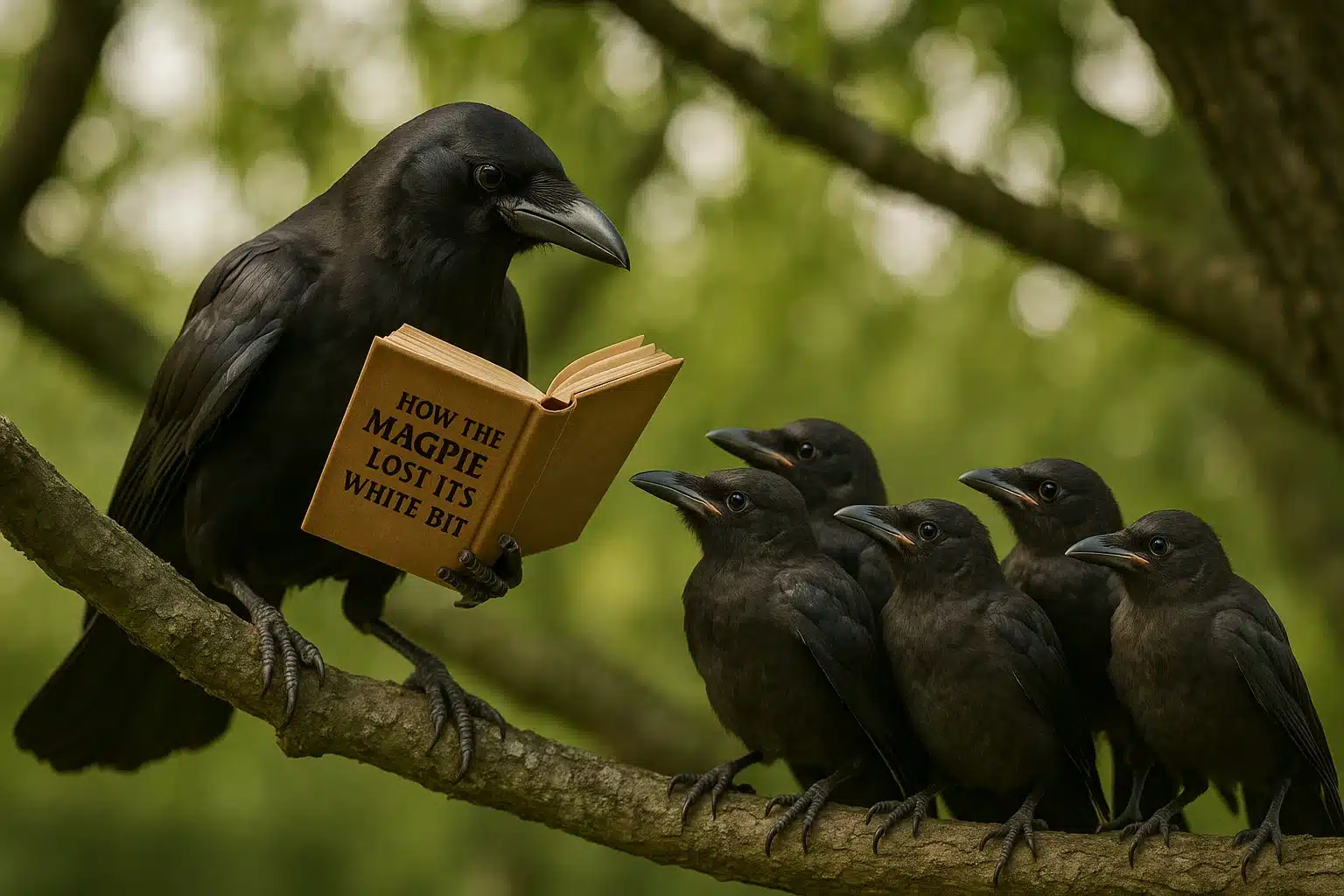
The crow perched on my garden fence wasn’t just cawing random outbursts. There were patterns to be discerned. Messages. As I listened to the piercing noise that had annoyed me for so long, I realised that the crow might actually be running with something.
Could it even be telling its family and friends a cautionary tale or imparting some important news? What else could I do but go and run a search on corvid communication?
With great interest, I discovered that recent research has revealed something remarkable—that crows don’t just signal, they construct narratives. They share complex information about past events, warn about specific threats, even pass down generational knowledge through what can only be described as storytelling.
This discovery holds profound implications not just for how we regard and treat animals, but for how we understand our own need for narrative and the therapeutic power of reshaping the stories that define us.
Murder Stories: How Crows Weave Their Yarns
Scientists studying crow communication have documented over 250 distinct vocalisations, each carrying specific meaning. But here’s where it gets fascinating: crows don’t just use isolated calls like alarm bells. They string together sequences that convey temporal information—what happened, when it happened, and what might happen next.
University of Washington researchers found that crows can communicate about events that occurred days or even years ago, effectively telling stories about dangerous humans who threatened them in the past.
The stories we tell about ourselves—whether we’re victims or survivors, whether we’re capable or inadequate—become self-fulfilling prophecies.
In one groundbreaking study, scientists wearing masks captured and banded crows for research. Years later, crows who had never encountered these masked individuals would aggressively scold anyone wearing the same mask.
The knowledge had been transmitted through generations via complex vocalisations—stories passed from parent to offspring about the ‘dangerous masked ones.’ This isn’t instinct or epigenetic inheritance. This is full-on cultural transmission through narrative.
Dr. John Marzluff’s research team also discovered that crows use what he calls ‘biographical information’ in their calls. They’re not just saying ‘danger’—they’re saying ‘remember that person with the white truck who disturbed our roost last Tuesday.’ They’re creating characters, plot points, and cautionary tales. They’re building identity narratives for their community.
The Human Story Imperative
This corvid storytelling reveals something fundamental about intelligence and survival: the ability to construct and share narratives isn’t just useful—it’s essential. For humans, this need runs even deeper. We don’t just tell stories; we are and we live our stories.
The narrative threads we weave about ourselves become the fabric of our identity.
Psychologists have long understood that humans are meaning-making machines. We constantly construct narratives to make sense of random events, to find patterns in chaos, and most importantly, to understand ourselves.
But unlike crows, whose stories serve survival in a more direct way, human narratives shape our entire psychological landscape. The stories we tell about ourselves—whether we’re victims or survivors, whether we’re capable or inadequate—become self-fulfilling prophecies.
Consider how you introduce yourself to someone new. You don’t just list facts, you craft a story. ‘I moved here after college, looking for adventure.’ ‘I’ve always been drawn to helping others.’ These aren’t just descriptions, they’re identity narratives that influence your future choices and behaviours.
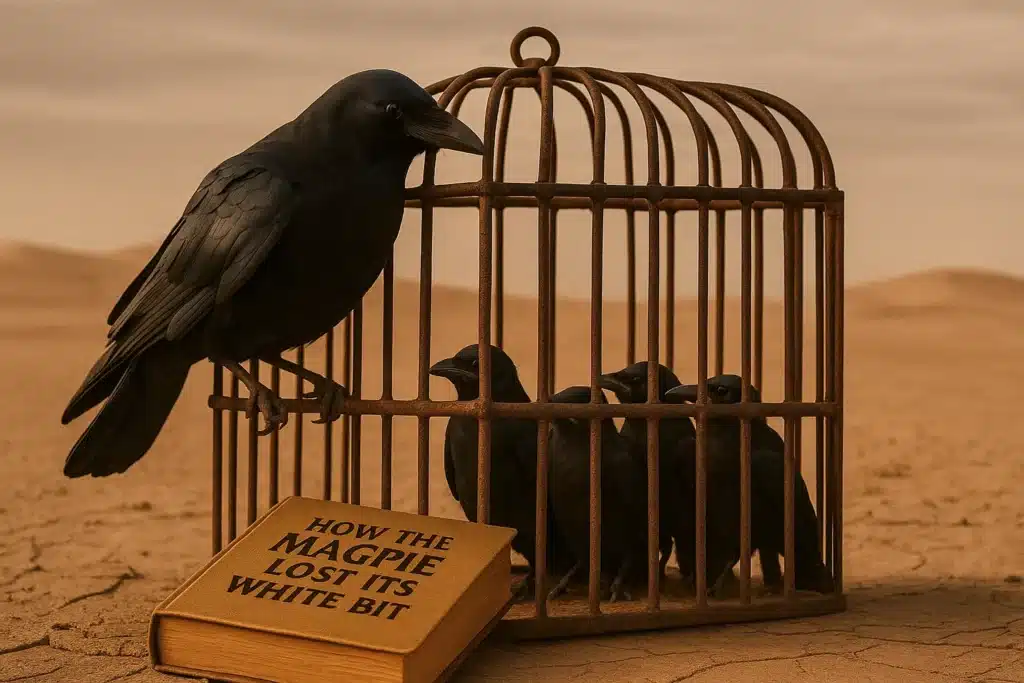
When Stories Become Cages
But what happens when our stories limit us? Unlike crows, who update their narratives based on new information, humans often cling to outdated stories about themselves. ‘I’m not good at relationships.’ ‘I always fail at the last moment.’ ‘I’m just an anxious person.’
As we’re becoming increasingly aware, these negative narratives, repeated internally thousands of times, become physical neural highways in our brains, making it difficult to imagine alternative possibilities.
A narrative of equal power needs to be introduced, and one that bypasses the conscious gatekeepers appointed by the parallel narratives of justification that have led us to set up our lives and relationships to accommodate these negative narratives and make them self-deniable.
This is where the intersection of corvid communication research and human psychology becomes particularly illuminating. Because crows demonstrate that stories are tools—functional, adaptable, and meant to serve, not suborn the storyteller.
When a narrative no longer serves its purpose, crows adjust it. They don’t remain perpetually afraid of all humans because one human was threatening. They refine their stories with specificity and nuance.
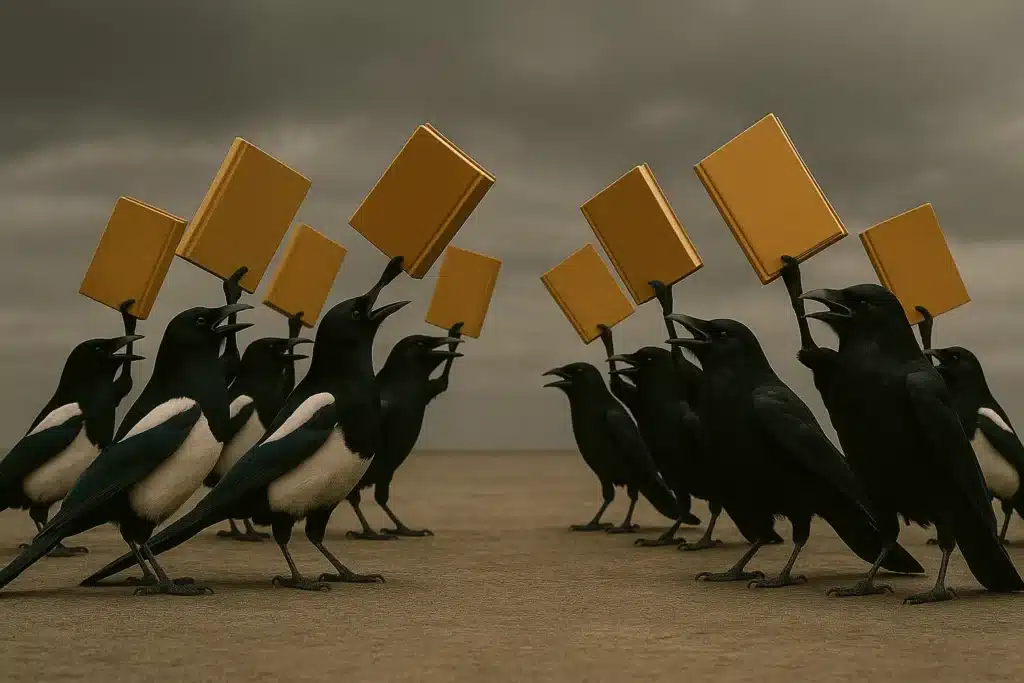
When Stories Become Lethal
In today’s world, we’re acutely aware of the ways in which narrative can be used to create tribal cohesion on the grand scale. And it’s true, nothing compares with story—particularly religious story—when it comes to unifying and galvanising a people against perceived or actual oppressors. A cone of silence inside which the bond is all the stronger for being based on an outlandish idea. And the more unbelievable the story, the stronger the bond.
Stories are meant to help us navigate our world, connect with others, and adapt to change.
But sometimes it’s not the age-old battle for resources and power that’s creating the problem, it’s the stories themselves—the imagined wrongs of legend, the tit-for-tat atrocities that happened two or three thousand years ago, the incessant barrage of thinly-veiled propaganda that fills cinema screens and TikTok pages.
If we can’t learn to unlearn these toxic histories, it’s highly likely that the crows won’t have to listen to our awful noise for very much longer.
Rewriting Our Flight Patterns
The therapeutic approach of narrative therapy, which I explore in The Making of Brio McPride, takes inspiration from this adaptive storytelling. Just as crows can learn to distinguish between threatening and benign humans, we can learn to separate ourselves from limiting narratives and author new ones.
This process isn’t about positive thinking or finding imaginative new ways to live in denial. It’s about recognising that we are both the author and the protagonist of our life story, and like any good writer, we can revise.
We can identify plot holes, develop character arcs, and most importantly, imagine different endings. In my own life, I’ve seen how powerful this re-authoring can be, and what happens when change remains beyond reach.
The Collective Story
Perhaps most remarkably, both crow and human narratives are inherently social. Crows share their stories to protect their community. Humans, too, need witnesses to our stories—people who can reflect back different perspectives, challenge our fixed narratives, and co-author new possibilities with us.
The rise of animal-assisted therapy, particularly with highly intelligent species, also hints at something profound—that sometimes we need to step outside human narrative altogether to see our own stories clearly.
Understanding how crows adapt their stories based on evidence and communicate without shame or judgment—how they update their narratives for individual and group survival—can surely inspire and guide us to approach our own stories with similar flexibility.
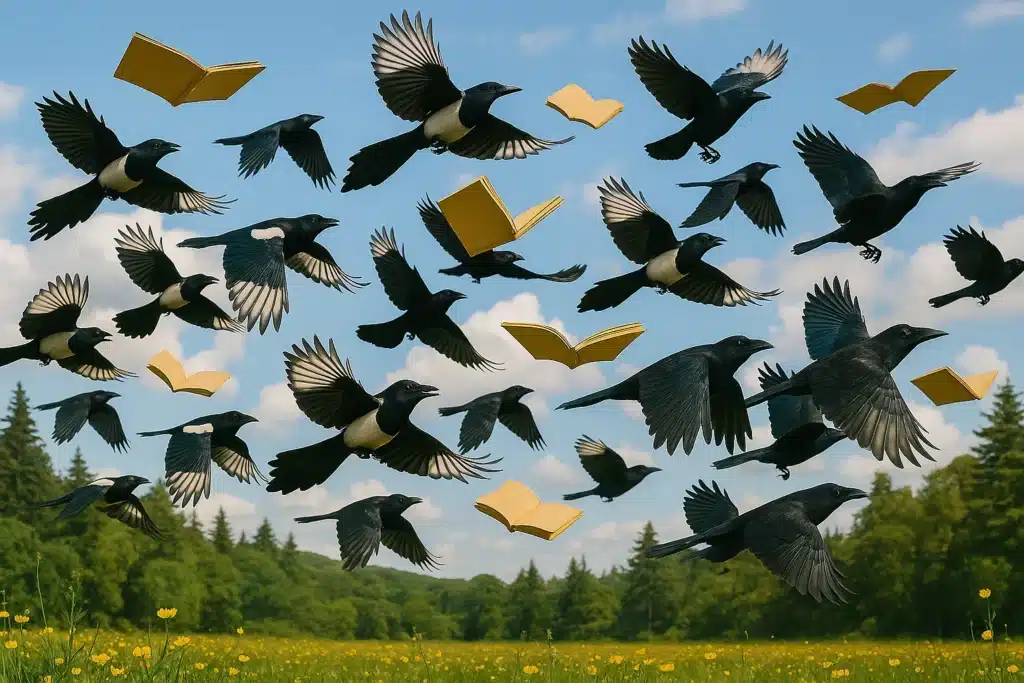
Flying Forward
Now, as I watch the crows in my garden—a regular gathering spot for their evening ‘discussions’—I can live with the comforting reminder that storytelling isn’t just a human quirk or entertainment. It’s a survival tool, refined over millions of years of evolution.
The crows teaching their young about the neighbourhood’s dangers don’t get stuck in loops of anxiety about past threats. They communicate what’s necessary, then adapt as needed and move forward. They demonstrate that stories should serve life, not create constraints.
Our identity narratives shape our reality as surely as crow calls shape their flock’s behaviour. But unlike our corvid cousins, we often forget that we are the authors. We mistake our stories for fixed truths rather than useful fictions that can be revised.
The research into corvid communication offers us a mirror—showing us both the power and the purpose of narrative. Stories are meant to help us navigate our world, connect with others, and adapt to change.
When they stop serving these functions, when they become cages or lethal ammunition rather than wings, it’s time to pick up the feathery quill and write something new.
***
Learn more about The Making of Brio McPride here, and to purchase, here.
30% of royalties go to support UK and US mental health charities.
Please connect with me on X, Facebook, and Instagram.