



Not So Crabby After All!
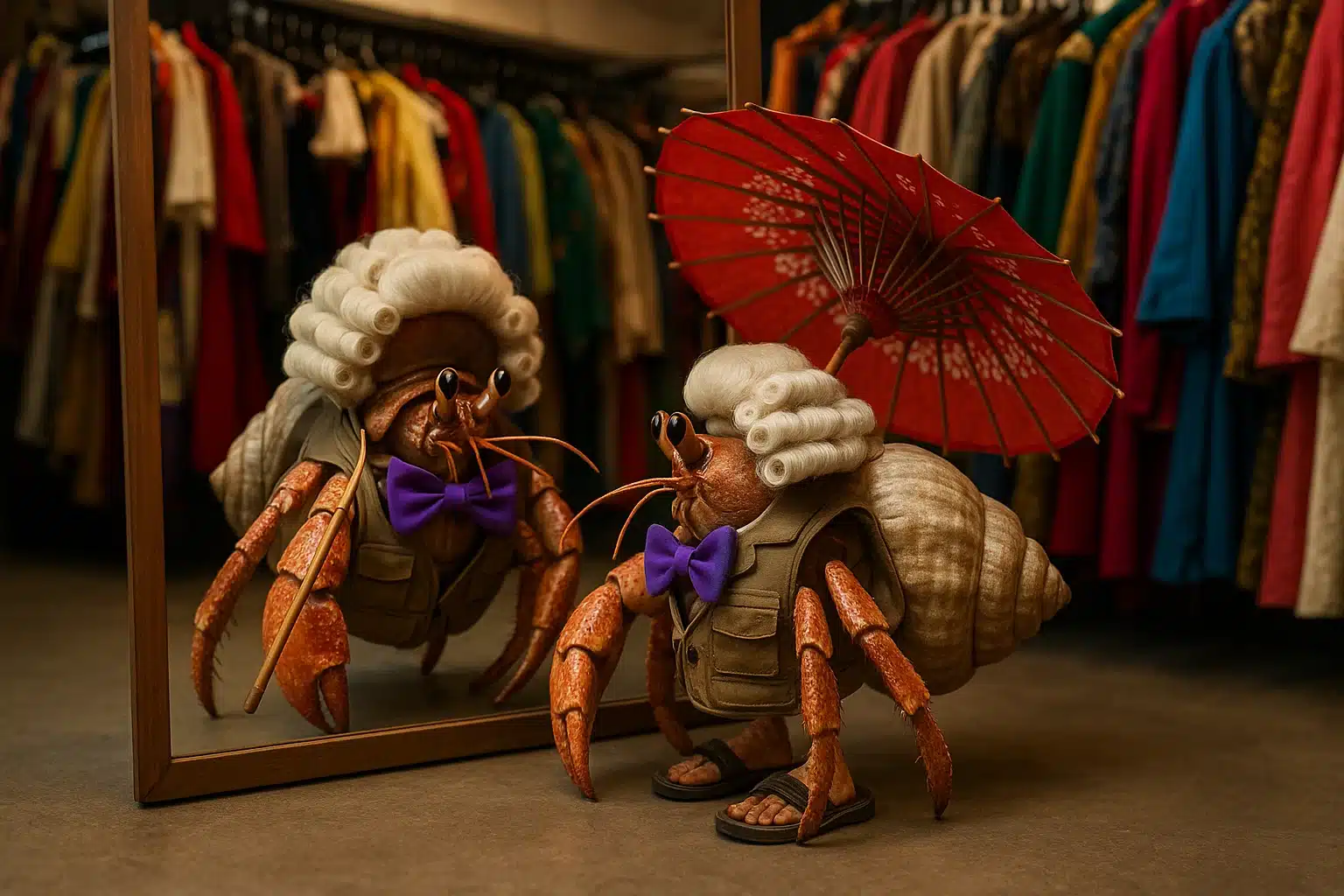
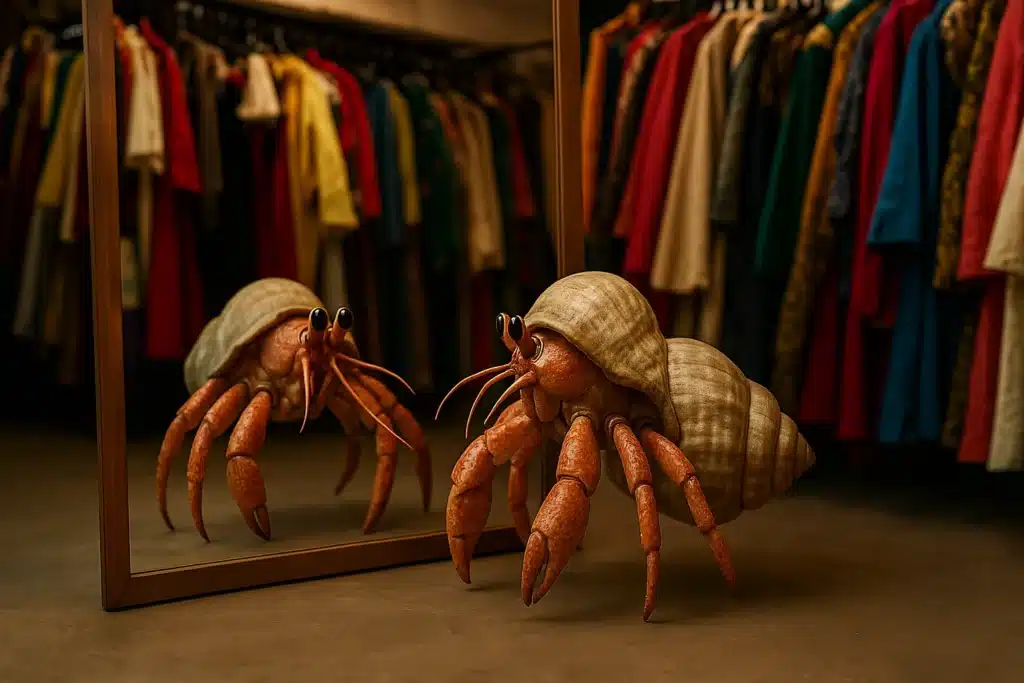
Hermit crabs aren’t actually crabs at all; they’re mini lobsters. And like hedgehogs, their bellies are soft and vulnerable. More of a bummer still, nature forgot to give them a shell of their own, so they have to go and find one themselves.
Then when they’re bigger, they need to go up a size and trade in their old shell. And hermit crabs continue growing as long as they live.
Likewise if their shell gets a ding, or if they see something better, hermit crabs get straight back to the store. Over a lifetime, a hermit crab might change shells dozens to potentially hundreds of times, and some species are full-on ‘shell shoppers’—like an aunt of mine who was always reinventing herself at the charity shop.
(Incidentally, there’s a costume and fancy-dress shop in The Making of Brio McPride. It’s called Costume Castle, and it’s where some of the main characters’ most formative moments happened.)
There’s something profoundly relatable about watching a hermit crab shop for a new shell. The little creature scuttles sideways toward a promising candidate, taps it with one cautious claw, circles it like a suspicious customer at a used car lot, and then—if the stars align—performs that magnificent wiggle-dance of moving in.
The thing about hermit crabs is that they’re remarkably practical about their shell choices.
Not Hermetic, Either!
Despite their name, hermit crabs aren’t just not crabs; they’re not hermits either. They’re social creatures who gather in groups to exchange shells in what marine biologists charmingly call ‘vacancy chains.’ When one crab finds a shell too big for its current size, it waits nearby while other crabs line up in order of size, and when the right-sized crab arrives, they all swap shells in sequence.
It’s like a combination of musical chairs and a clothing swap, but with higher stakes—your entire home is on the line!
Isn’t this a great metaphor for how we humans try on new identities throughout our lives? We rarely make these changes in isolation. Instead, we gather in our own vacancy chains—friend groups, online communities, workplaces—waiting for someone to flaunt the perfect ‘shell’ of an identity that might fit us better than what we’re currently wearing. Down to the shell store we go to pick up something that matches as closely as possible.
Consider the experience of arriving at uni or a new job and realising you could actually be anyone you want now. Nobody knew that you played the recorder poorly in year three or that you once cried during athletics day. You could be:
Intellectual You, who carries around a copy of Sartre (unread, but prominently displayed).
Creative You, carrying your paper notebook and a pencil wherever you go.
Gregarious You, never declining an invite even though you know you’re going to struggle with every minute of the party.
Outdoorsy You, despite your most ambitious hike being from the parking lot to the campus coffee shop.
The possibilities feel endless, and like a hermit crab presented with a beach full of shells, you might spend your entire first/freshman year trying on different versions of yourself.
The thing about hermit crabs is that they’re remarkably practical about their shell choices. They need something that fits their soft, vulnerable abdomen perfectly—not too tight, not too loose, with enough room to grow but not so much that they rattle around like a marble in a tin can. They test the weight, check for holes, and ensure they can fully retreat inside when threatened.
We could learn something from this very natural and orderly approach!
Optics Versus The Genuinely Optimal
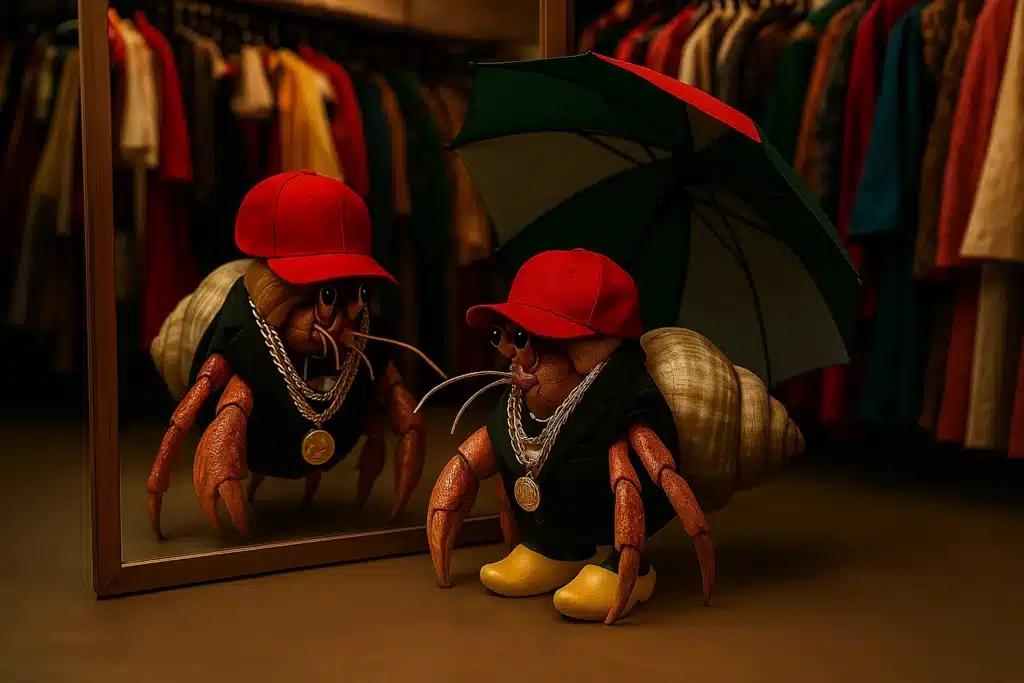
Too often, we choose our identity ‘shells’ based on how they look from the outside rather than how they feel from within. We squeeze ourselves into identities that pinch because they photograph well on social media.
We drag around shells so heavy with others’ expectations that we can barely move forward. Or we pick shells so large—trying to seem more important or accomplished than we feel—that we get lost inside them, our authentic voice echoing uselessly in all that empty space.
But here’s what hermit crabs know that we sometimes forget—that changing shells doesn’t signify failure. It’s all about growth. A hermit crab doesn’t feel shame when it needs to size up.
It doesn’t apologise to the other crabs for outgrowing what used to fit perfectly. It simply recognises that what once served it well no longer does, and it moves on to find something better suited to who it’s become.
If a shell becomes too small, it doesn’t just look bad, it cramps your style. It’s almost a jail cell. If you want to grow as an individual, you need to come out of that shell, even if you don’t have anything else lined up.
You have to have all that vulnerability hanging out till you can find something that really works. But if you don’t put it all on the line, you’re going to shrivel in your old shell for sure.
This is why we need to channel our inner hermit crab. We have to accept change and roll with it all the way. Otherwise we’ll be like one of the main characters in The Making of Brio McPride, hardly able to breathe or function because their precious safety harness was too tight, but they were so dependent on it for a sense of safety, so fearful of breaking faith and the bond with the cherished elder who gave it to them, that they have no way to grow.
There’s wisdom in this economy of identity—in not cluttering our sense of self with who we used to be or who we thought we’d become.
The pandemic years taught many of us this lesson viscerally. Identities we’d worn for years—Fearless Warrior, Social Butterfly, Snappy Dresser, Gym Junkie—these suddenly didn’t fit in a world of lockdowns and Zoom calls.
We had to scramble for new shells: Amateur Doctor, Television Addict, Fearful Person Trying to Look Tough. Some of these temporary shells we’ve since abandoned by the wayside like outgrown husks. Others, surprisingly—or annoyingly—we’ve kept.
The World is Your Oyster!
Perhaps the most graceful approach to identity is to hold it lightly, like a hermit crab who knows that this shell, no matter how perfect it seems right now, is temporary.
You’re allowed to:
Be the person who did yoga every day for three years and then stopped.
Pursue a career with passion and then change direction entirely.
Outgrow friendships, hobbies, and even fundamental beliefs about yourself.
The hermit crab doesn’t carry around every shell it’s ever inhabited, dragging the weight of all its former selves. It keeps only what serves it in the present moment. There’s wisdom in this economy of identity—in not cluttering our sense of self with who we used to be or who we thought we’d become.
Next time you feel that uncomfortable pinch of an identity that no longer fits, remember the hermit crab. Remember that somewhere out there, someone might be abandoning exactly the shell you need.
Remember also that growth requires vulnerability—that soft, exposed moment between shells when you’re neither who you were nor who you’re becoming.
Hermit crabs never get to escape that cycle of feeling safe and being forced out into the open to start again. So, as with us and our constantly evolving identities, they never really get to find their ‘forever home’, because that’s not the point of the great journey we call life. They just keep getting bigger and better.
***
Learn more about The Making of Brio McPride here, and to purchase, here.
30% of royalties go to support UK and US mental health charities.
Please connect with me on X, Facebook, and Instagram.