




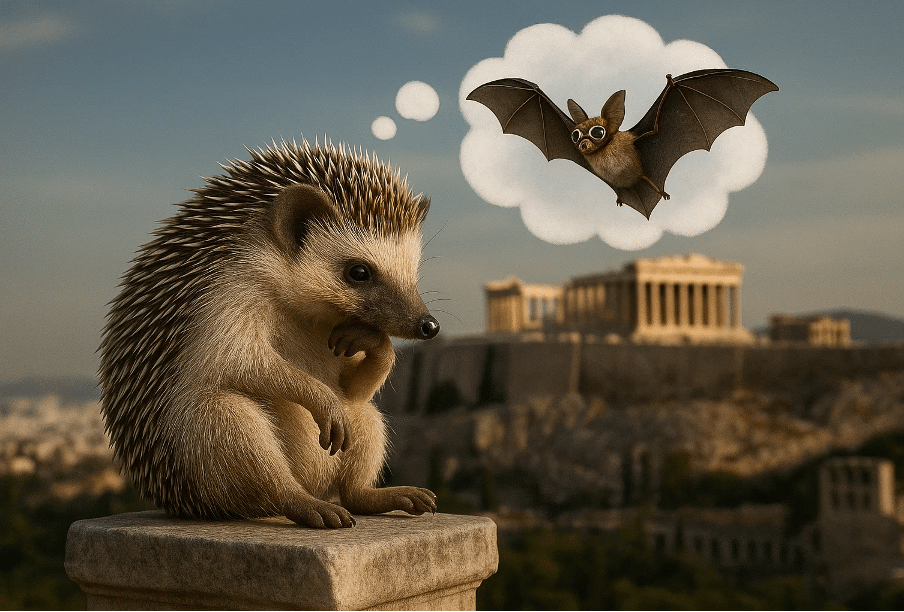
The Heart of a Hedgehog
Everyone loves hedgehogs, and anyone who doesn’t feel bad when they see one flattened on the road has surely been brutalised in some way that’s deserving of pity and care. I can’t imagine how I’d feel if I ever ran one over—or rather I know how I’d feel, I just don’t know to what lengths I’d go in taking care of its earthly remains.
I suspect that I’d park the car and try to find some flowers, give it something close to a state funeral, and sing to it, mumble prayers. If I didn’t sob openly like a little kid as I did when my dog died, it would only be because there were strangers present. By the time the ceremony was over, I’d most likely have missed the appointment with my therapist.
The experience of laying the hedgehog to rest would also lead me to reflect quite anxiously about whether animals have souls, which would take me straight to the question of what is a soul—and since that’s a question that goes nowhere, I’d just collapse into a state of distress about the kind of family the departed hedgehog would have had waiting for it at home.
Being no zoologist, I wouldn’t know whether I’d killed a mum or a dad or a much-loved granny. In my debilitating guilt, I’d assume the worst. (And never text when you’re driving.)
For the small subsection of society that hasn’t yet read The Making of Brio McPride, the reason my own interest in hedgehogs came from writing this novel is because I needed an animal character to represent the vulnerable inner part of all of us.
In a candidate field that included everything from the common field mouse to the cotton-top tamarin and red panda, what clinched it for the hedgehog was its cute-but-effective little spikes, which perfectly symbolise the way in which we try to shield that vulnerable inner part of ourselves.
Even the spikes have a sense of vulnerability—less wicked-looking than those of, say, a porcupine, an Australian/New Guinean echidna, or a Madagascan tenrec.
This learning ability implies they can hold information in working memory and use past experiences to guide future behaviour
No wonder the hedgehog has captured human hearts for centuries or even millennia. The cute waddle, the endearing snuffles, the fluffy underbelly, and those beady little eyes that look intelligent and watchful without anything in the way of guile or criminality.
In Brio—minor spoiler alert—the hedgehog is a talking psychological avatar and very different to the way animals are used in cartoons and family feature animations. This led me to wondering more than casually about the nature of consciousness in animals—in hedgehogs, in particular—and whether they have what we lovingly call ‘imagination’.
Whether they have a ‘soul’ is interesting too, but my interest in hedgehog consciousness was more pop-scientific than theological, and most of a blog on the subject of souls would have centred on whether anyone actually has one.
To me, the answer to that question is, yes, of course they do, I just don’t know what a soul is. Nor does anyone. But for sure, if I’ve got one, then so too does a hedgehog. And vice versa.
Understanding Consciousness in Animals
The question of whether hedgehogs have consciousness touches on fundamental issues in neuroscience and animal cognition. In terms of philosophy of mind, the question ‘what is consciousness?’ has also had scientists and deep thinkers at each other’s throats for years. So first, we do have to have a little grapple with what ‘consciousness’ means.
At its most basic, consciousness refers to subjective experience—the feeling of ‘what it’s like’ to be something. The very private and dryly amusing philosopher Thomas Nagel illustrated this concept by asking what it’s like to be a bat, arguing that if there’s ‘something it is like’ to be a bat, then bats are ‘conscious’.
This approach (which is of the phenomenological school of thought, in case you’re interested) suggests that consciousness isn’t just about processing information but about experiencing it subjectively. The point seems to be a rather fine one, but best just to nod knowledgeably and go with the flow.
And it must be acknowledged that we don’t even encounter this kind of advanced scent-triggered behaviour in the perfume department at Bergdorf Goodman.
More interestingly, perhaps, scientists generally distinguish between different levels of consciousness. Primary consciousness involves basic awareness of the present moment—sensing pain, pleasure, or environmental stimuli. Higher-order consciousness includes things like self-awareness and the ability to think about thinking, perhaps even imagination.
Most researchers seem to agree that many mammals possess at least primary consciousness, but the distribution of higher-order consciousness remains hotly debated. It’s tempting to think there might also be a wide scale of levels of consciousness within the human race. I guess we’d need to ask a hedgehog.
The Brain of a Hedgehog Brain: Small but Sophisticated
Although their brain-to-body ratio falls within the range typical of small mammals, and their neural architecture shares fundamental similarities with other mammals, including humans, hedgehogs possess surprisingly complex brains for their size.
Specifically, they have a discernible cerebral cortex (though less folded than in larger mammals), a limbic system for processing emotions and memories, and sensory processing regions that integrate multiple inputs.
I don’t know about you, but whenever I hear or read the term ‘limbic system’, I begin to feel quite warm and fuzzy. It’s the cerebral cortex that’s generally associated with consciousness.
Particularly interesting is the hedgehog’s well-developed olfactory system, which dominates much of their brain structure. This suggests that their conscious experience might be profoundly shaped by scent in ways humans can barely imagine.
Their somatosensory cortex, which processes touch sensations, is also very well developed, which I guess is unsurprising given that their unique spiny covering must require some pretty sophisticated tactile processing.

Behavioural Evidence for Consciousness
As a matter of principle, I wholeheartedly agree with all the scientists who believe that hedgehog behaviour itself provides compelling evidence of consciousness. Clear responses to pain and pleasure, seeking out comfortable environments, avoiding harmful stimuli, a preference for certain foods, environments, and even social situations—all this shows very clear evidence that subjective experiences guide their choices.
And although generally I can’t help cleaving to the trendy but boring bio-chemical explanation for absolutely everything, all driven by genes, in the case of hedgehogs this type of behaviour can only mean an almost metaphysical ‘consciousness’.
This learning ability implies … mystical qualities beyond the power of the average human imagination!
The self-anointing behaviour of hedgehogs is another grand mystery—this being the bit where they contort themselves as though playing Twister to spread frothy saliva on their spines. This happens when they come upon new scents, and counts as a complex behaviour sequence that requires sustained attention and appears to serve no immediate survival function—which hints strongly at internal experiences beyond simple stimulus-response patterns.
(And it must be acknowledged that we don’t even encounter this kind of advanced scent-triggered behaviour in the perfume department at Bergdorf Goodman.)
Hedgehogs also display individual personalities. Some are bold explorers, while others remain cautiously defensive. They can form attachments to specific humans or other hedgehogs, recognising individuals and modifying their behaviour accordingly.
How does this kind of individual variation and social recognition not provide irrefutable evidence for an inner life shaped by unique experiences and preferences? … even if it is driven by bio-chemicals.
Memory, Learning, and Problem-Solving
Hedgehog learning and memory only stacks the evidence higher, because they can navigate mazes and remember feeding locations, and learn to associate certain sounds with food rewards. They demonstrate spatial memory, creating mental maps of their territories that span several acres in the wild. In captivity, they learn routines, anticipate feeding times, and even appear to recognise their names.
They can also be trained to use litter boxes and respond to basic commands, showing they can form associations between actions and outcomes. This learning ability implies they can hold information in working memory and use past experiences to guide future behaviour—all hallmarks of conscious processing … probably even a sign of mystical qualities beyond the power of the average human imagination! Which brings us to:
The Imagination Question
Whether hedgehogs possess imagination—the ability to mentally simulate scenarios not currently present—admittedly remains more speculative, though mainly because most humans lack the imagination to imagine hedgehog imagination.
True, imagination (as we call it) likely requires higher-order consciousness that may be limited to species with more developed prefrontal cortices, but it’s the behavioural observations not the boring grey matter that suggest rudimentary imaginative capacities. Hedgehogs obviously just keep their prefrontal cortices well hidden from the gaze of conceited and envious humans.
Needless to say, hedgehogs exhibit REM sleep patterns similar to those associated with dreaming in humans. Their legs twitch, they make soft vocalisations, and their eyes move beneath closed lids.
While we cannot know their subjective experience during these states, the neurological similarities to human dreaming strongly suggest that they experience some form of mental simulation. Which basically means they do. And if we understood those little vocalisations, we’d no doubt realise that they sleep talk too.
Hurrah for the hedgehog! Hurrah for the Hoggit! And do please read the novel when you have a moment.
And if all that isn’t enough to convince you that our spiky friends are more profound than humans (and smarter than magpies), witness please the play behaviour in young hedgehogs. That’s right, juvenile hedgehogs engage in activities that patently serve no immediate survival purpose—pushing objects around, exploring without seeking food, and engaging in mock defensive behaviours.
Whether this is all instinct and inherited behaviour patterns—and okay, it probably is—the point is that their play involves practicing future scenarios, which requires the ability to conceive (ie imagine) situations beyond the immediate present.
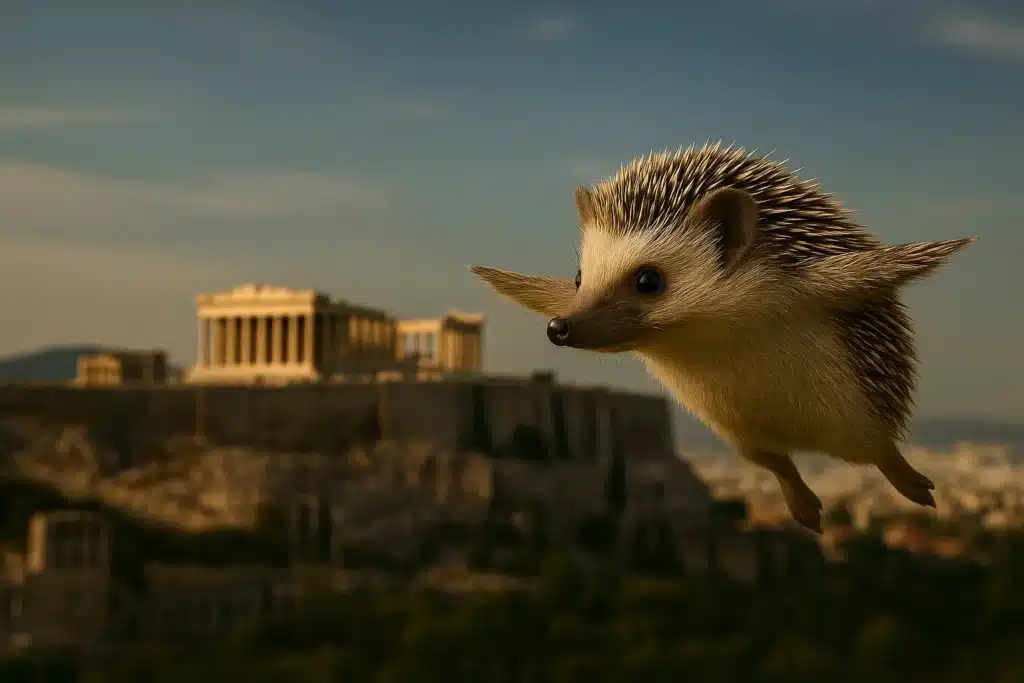
The Scientific Consensus and Ongoing Debates
Getting really serious now, to definitively douse the doubters (since you obviously think I might be a bit too in thrall of hedgehogs)—the Cambridge Declaration on Consciousness, signed by prominent neuroscientists in 2012, acknowledged that non-human animals, including mammals and even some non-mammals, possess consciousness.
This declaration specifically noted that animals with brain structures different from humans can still generate conscious experiences. Given hedgehogs’ mammalian brain structure and behavioural complexity, most self-respecting scientists would place them within the realm of conscious creatures.
In less educated and under-imaginative scientific circles, the degree and nature of hedgehog consciousness remains debated. Their consciousness might differ a little bit from human consciousness—and perhaps (though not definitely) lack our linguistic inner monologue or abstract reasoning capabilities.
But even if this were true, hedgehog consciousness is still undoubtedly a rich tapestry of sensory experiences, emotional states, and spatial awareness that we must acknowledge and act upon, even if we’re too intellectually stunted to fully comprehend.
The Heart and Mind of a Hedgehog
Genuinely serious stuff now—because the question of hedgehog consciousness isn’t just bloggishly quasi-academic, it has practical and ethical implications too.
Meaning that, if hedgehogs are conscious beings capable of suffering and perhaps even imagination, this affects how we should treat them in captivity and during research, and how we (not they) should go the extra mile when our habitats intersect with theirs.
Ultimately, the high probability of hedgehog consciousness reminds us that the inner lives of other species are both genuinely real and fundamentally alien to our own experience.
The big takeaway being that as we continue to study these remarkable creatures, we might find that consciousness, like evolution itself, admits to countless variations on a theme—each species inhabiting its own unique experiential world.
In contemplating hedgehog consciousness, we’re reminded that the universe might be filled with myriad forms of awareness, each valuable in its own right, each deserving of our respect and consideration.
To me, it seems highly likely that the hedgehog is a divine creature that arrived in mysterious, probably magical, circumstances, and lives among us as a watcher sent by our Creator to prepare the way for some kind of cataclysmic though wonderful restart of life on Planet Earth.
Hurrah for the hedgehog! Hurrah for the Hoggit!
And do please read the novel when you have a moment.
Grown-Up References on Animal Consciousness and Cognition
On consciousness in animals generally:
- Nagel, T. (1974). “What is it like to be a bat?” The Philosophical Review, 83(4), 435-450.
- Low, P., et al. (2012). The Cambridge Declaration on Consciousness. Francis Crick Memorial Conference on Consciousness in Human and non-Human Animals, Cambridge, UK.
- Griffin, D. R. (2001). Animal Minds: Beyond Cognition to Consciousness. University of Chicago Press.
On hedgehog biology and behaviour:
- Reeve, N. (1994). Hedgehogs. T & AD Poyser Natural History.
- Morris, P. (2018). Hedgehog. Collins New Naturalist Library.
- Wroot, A. J. (1984). “Feeding ecology of the European hedgehog.” Journal of Zoology, 203(1), 79-92.
On hedgehog neurology and cognition:
- Herculano-Houzel, S. (2017). “Numbers of neurons as biological correlates of cognitive capability.” Current Opinion in Behavioral Sciences, 16, 1-7.
- Vallortigara, G., & Rogers, L. J. (2005). “Survival with an asymmetrical brain: advantages and disadvantages of cerebral lateralization.” Behavioral and Brain Sciences, 28(4), 575-589.
On animal sleep and potential dreaming:
- Siegel, J. M. (2005). “Clues to the functions of mammalian sleep.” Nature, 437(7063), 1264-1271.
- Peever, J., & Fuller, P. M. (2017). “The biology of REM sleep.” Current Biology, 27(22), R1237-R1248.
On play behaviour in mammals:
- Burghardt, G. M. (2005). The Genesis of Animal Play: Testing the Limits. MIT Press.
- Pellis, S., & Pellis, V. (2009). The Playful Brain: Venturing to the Limits of Neuroscience. Oneworld Publications.
***
Learn more about The Making of Brio McPride here, and to purchase, here.
30% of royalties go to support UK and US mental health charities.
Please connect with me on X, Facebook, and Instagram.